Page 967 - techequipmentscatalogue2016
P. 967
FL.UKE ®
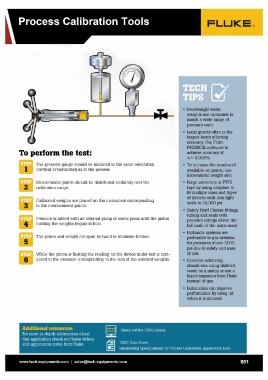
To perform the test: • Deadweight tester
weights are calibrated to
The pressure gauge should be mounted in the same orientation match a wide range of
(vertical or horizontal) as in the process. pressure units.
Measurement points should be distributed uniformly over the • Local gravity often is the
calibration range. largest factor affecting
accuracy. Use Fluke
Calibrated weights are placed on the instrument corresponding PRESSCAL software to
to the measurement points. achieve accuracy of
Pressure is added with an internal pump or screw press until the piston +/- 0.008%.
holding the weights begins to float.
To increase the number of
The piston and weight are spun by hand to minimize friction. available set points, use
incremental weight sets.
While the piston is floating the reading on the device under test is com-
• Forgo wrenches or PTFE
6 pared to the pressure corresponding to the sum of the selected weights. tape by using adapters to
fit multiple sizes and types
of devices with leak tight
seals to 20,000 psi.
• Safety First! Choose fittings,
tubing and seals with
pressure ratings above the
full scale of the instrument.
• Hydraulic systems are
preferable to gas systems
for pressures above 2000
psi due to safety and ease
of use.
• Consider achieving
cleanliness using distilled
water as a media or use a
liquid separator from Fluke
instead of gas.
• Lubrication can improve
performance by using oil
when it is allowed.
www.tech-equipments.comlsales@tech-equipments.com 961
To perform the test: • Deadweight tester
weights are calibrated to
The pressure gauge should be mounted in the same orientation match a wide range of
(vertical or horizontal) as in the process. pressure units.
Measurement points should be distributed uniformly over the • Local gravity often is the
calibration range. largest factor affecting
accuracy. Use Fluke
Calibrated weights are placed on the instrument corresponding PRESSCAL software to
to the measurement points. achieve accuracy of
Pressure is added with an internal pump or screw press until the piston +/- 0.008%.
holding the weights begins to float.
To increase the number of
The piston and weight are spun by hand to minimize friction. available set points, use
incremental weight sets.
While the piston is floating the reading on the device under test is com-
• Forgo wrenches or PTFE
6 pared to the pressure corresponding to the sum of the selected weights. tape by using adapters to
fit multiple sizes and types
of devices with leak tight
seals to 20,000 psi.
• Safety First! Choose fittings,
tubing and seals with
pressure ratings above the
full scale of the instrument.
• Hydraulic systems are
preferable to gas systems
for pressures above 2000
psi due to safety and ease
of use.
• Consider achieving
cleanliness using distilled
water as a media or use a
liquid separator from Fluke
instead of gas.
• Lubrication can improve
performance by using oil
when it is allowed.
www.tech-equipments.comlsales@tech-equipments.com 961