Page 976 - techequipmentscatalogue2016
P. 976
UKE ®
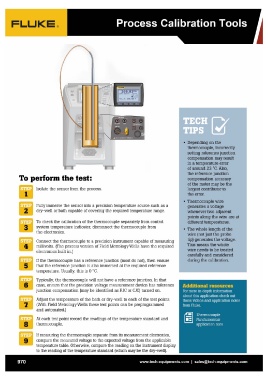
To perform the test: • Depending on the
thermocouple, incorrectly
Isolate the sensor from the process. setting reference junction
compensation may result
Fully immerse the sensor into a precision temperature source such as a in a temperature error
dry-well or bath capable of covering the required temperature range. of around 23 °e. Also,
the reference junction
To check the calibration of the thermocouple separately from control compensation accuracy
system temperature indicator, disconnect the thermocouple from of the meter may be the
the electronics. largest contributor to
the error.
Connect the thermocouple to a precision instrument capable of measuring
millivolts. (The process version of Field Metrology Wells have the required • Thermocouple wire
electronics built in.) generates a voltage
whenever two adjacent
If the thermocouple has a reference junction (most do not), then ensure points along the wire are at
that the reference junction is also immersed at the required reference different temperatures.
temperature. Usually, this is 0 °C.
• The whole length of the
Typically, the thermocouple will not have a reference junction. In that wire (not just the probe
case, ensure that the precision voltage measurement device has reference tip) generates the voltage.
junction compensation (may be identified as RJC or CJC) turned on. This means the whole
wire needs to be treated
Adjust the temperature of the bath or dry-well to each of the test points. carefully and considered
(With Field Metrology Wells these test points can be preprogrammed during the calibration.
and automated.)
Additional resources
At each test point record the readings of the temperature standard and
thermocouple. For more in depth information
about this application check out
these videos and application notes
from Fluke.
l!=.J(!!l Thermocouple
Fundamentals
application note
If measuring the thermocouple separate from its measurement electronics,
9 compare the measured voltage to the expected voltage from the applicable
temperature table. Otherwise, compare the reading on the instrument display
to the reading of the temperature standard (which may be the dry-well).
970 www.tech-equipments.comlsales@tech-equipments.com
To perform the test: • Depending on the
thermocouple, incorrectly
Isolate the sensor from the process. setting reference junction
compensation may result
Fully immerse the sensor into a precision temperature source such as a in a temperature error
dry-well or bath capable of covering the required temperature range. of around 23 °e. Also,
the reference junction
To check the calibration of the thermocouple separately from control compensation accuracy
system temperature indicator, disconnect the thermocouple from of the meter may be the
the electronics. largest contributor to
the error.
Connect the thermocouple to a precision instrument capable of measuring
millivolts. (The process version of Field Metrology Wells have the required • Thermocouple wire
electronics built in.) generates a voltage
whenever two adjacent
If the thermocouple has a reference junction (most do not), then ensure points along the wire are at
that the reference junction is also immersed at the required reference different temperatures.
temperature. Usually, this is 0 °C.
• The whole length of the
Typically, the thermocouple will not have a reference junction. In that wire (not just the probe
case, ensure that the precision voltage measurement device has reference tip) generates the voltage.
junction compensation (may be identified as RJC or CJC) turned on. This means the whole
wire needs to be treated
Adjust the temperature of the bath or dry-well to each of the test points. carefully and considered
(With Field Metrology Wells these test points can be preprogrammed during the calibration.
and automated.)
Additional resources
At each test point record the readings of the temperature standard and
thermocouple. For more in depth information
about this application check out
these videos and application notes
from Fluke.
l!=.J(!!l Thermocouple
Fundamentals
application note
If measuring the thermocouple separate from its measurement electronics,
9 compare the measured voltage to the expected voltage from the applicable
temperature table. Otherwise, compare the reading on the instrument display
to the reading of the temperature standard (which may be the dry-well).
970 www.tech-equipments.comlsales@tech-equipments.com