Page 262 - techequipmentscatalogue2016
P. 262
tronix®
/
Signal Generators
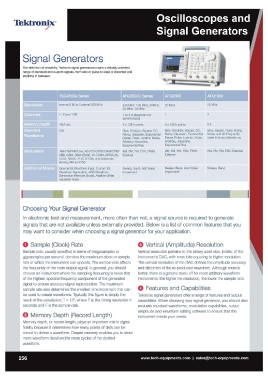
The definition of versatility, Tektronix signal generators create a virtually unlimited
range of standard and custom signals, from sine or pulse to ideal or distorted and
anything in between.
TSG4100A Series AFG3000C Series AFG2000 AFG1000
Internal 6 MHz, External 200 MHz 240 MHz, 100 MHz, 50MHz, 20 MHz 25 MHz
25 MHz, 10 MHz
1 LF and 1 RF 1 or 2 Ondependent or 2
synchronized}
16M b~s 4 x 128 k points 4 x 128 k points 8k
CW Sine, Sine(x}/x, Square, DC, Sine, Sine(x}/x, Square, DC, Sine, Square, Pulse, Ramp,
:0 Ramp, Gaussian, Exponential Ramp, Gaussian, Exponential Noise, and 45 Frequently
Decay, Pulse, Lorentz, Noise, Decay, Pulse, Lorentz, Noise, Used Arbitrary Waveforms
Arbitrary, Haversine, Arb~rary, Haversine,
Exponential Rise Exponential Rise
AM/FMlPMlPulse, ASKlFSKlPSKlQAMlCPMI AM , FM, PM, FSK, PWM, AM, FM, PM, FSK, PWM, AM , FM, PM, FSK, External
External Sweep, Burst
VSB, GSM, GSM-EOOE, W-CDMA,APCO-25, External
Sweep, Burst, Add Noise
• 00 0 DECT, NADC, PDC,TETRA, and Audio clip Sweep, Burst, Add Noise Impairment
.. (Analog AM and FM) Impairment
; ExternallQ Waveform Input, Custom IQ
Waveform Generation, ARB Waveform
Generation (Remote Mode), Add~ive White
Gaussian noise
Choosing Your Signal Generator
In electronic test and measurement, more often than not, a signal source is required to generate
signals that are not available unless externally provided, Below is a list of common features that you
may want to consider when choosing a signal generator for your application.
o Sample (Clock) Rate o Vertical (Amplitude) Resolution
Sample rate, usually specified in terms of megasamples or Vertical resolution pertains to the binary word size, in bits, of the
gigasamples per second , denotes the maximum clock or sample instrument's DAC, with more bits equating to higher resolution.
rate at which the instrument can operate. The sample rate affects The vertical resolution of the DAC defines the amplitude accuracy
the frequency of the main output signal. In general, you should and distortion of the re-produced waveform. Although more is
choose an instrument where the sampling frequency is twice that better, there is a general trade-off for most arbitrary waveform
of the highest spectral frequency component of the generated instruments; the higher the resolution, the lower the sample rate.
signal to ensure accurate signal reproduction. The maximum
sample rate also determines the smallest time increment that can o Features and Capabilities
be used to create waveforms. Typically this figure is simply the
Tektronix signal generators offer a range of features and output
result of the calculation; T = 1IF, where T is the timing resolution in capabilities. When choosing your signal generator, you should also
evaluate standard waveforms, modulation capabilities, output
seconds and F is the sample rate. amplitude and waveform editing software to ensure that the
instrument meets your needs.
8 Memory Depth (Record Length)
Memory depth, or record length, plays an important role in signal
fidelity because it determines how many points of data can be
stored to define a waveform. Deeper memory enables you to store
more waveform detail andlor more cycles of the desired
waveform .
256 www.tech-equipments.comlsales@tech-equipments.com
/
Signal Generators
The definition of versatility, Tektronix signal generators create a virtually unlimited
range of standard and custom signals, from sine or pulse to ideal or distorted and
anything in between.
TSG4100A Series AFG3000C Series AFG2000 AFG1000
Internal 6 MHz, External 200 MHz 240 MHz, 100 MHz, 50MHz, 20 MHz 25 MHz
25 MHz, 10 MHz
1 LF and 1 RF 1 or 2 Ondependent or 2
synchronized}
16M b~s 4 x 128 k points 4 x 128 k points 8k
CW Sine, Sine(x}/x, Square, DC, Sine, Sine(x}/x, Square, DC, Sine, Square, Pulse, Ramp,
:0 Ramp, Gaussian, Exponential Ramp, Gaussian, Exponential Noise, and 45 Frequently
Decay, Pulse, Lorentz, Noise, Decay, Pulse, Lorentz, Noise, Used Arbitrary Waveforms
Arbitrary, Haversine, Arb~rary, Haversine,
Exponential Rise Exponential Rise
AM/FMlPMlPulse, ASKlFSKlPSKlQAMlCPMI AM , FM, PM, FSK, PWM, AM, FM, PM, FSK, PWM, AM , FM, PM, FSK, External
External Sweep, Burst
VSB, GSM, GSM-EOOE, W-CDMA,APCO-25, External
Sweep, Burst, Add Noise
• 00 0 DECT, NADC, PDC,TETRA, and Audio clip Sweep, Burst, Add Noise Impairment
.. (Analog AM and FM) Impairment
; ExternallQ Waveform Input, Custom IQ
Waveform Generation, ARB Waveform
Generation (Remote Mode), Add~ive White
Gaussian noise
Choosing Your Signal Generator
In electronic test and measurement, more often than not, a signal source is required to generate
signals that are not available unless externally provided, Below is a list of common features that you
may want to consider when choosing a signal generator for your application.
o Sample (Clock) Rate o Vertical (Amplitude) Resolution
Sample rate, usually specified in terms of megasamples or Vertical resolution pertains to the binary word size, in bits, of the
gigasamples per second , denotes the maximum clock or sample instrument's DAC, with more bits equating to higher resolution.
rate at which the instrument can operate. The sample rate affects The vertical resolution of the DAC defines the amplitude accuracy
the frequency of the main output signal. In general, you should and distortion of the re-produced waveform. Although more is
choose an instrument where the sampling frequency is twice that better, there is a general trade-off for most arbitrary waveform
of the highest spectral frequency component of the generated instruments; the higher the resolution, the lower the sample rate.
signal to ensure accurate signal reproduction. The maximum
sample rate also determines the smallest time increment that can o Features and Capabilities
be used to create waveforms. Typically this figure is simply the
Tektronix signal generators offer a range of features and output
result of the calculation; T = 1IF, where T is the timing resolution in capabilities. When choosing your signal generator, you should also
evaluate standard waveforms, modulation capabilities, output
seconds and F is the sample rate. amplitude and waveform editing software to ensure that the
instrument meets your needs.
8 Memory Depth (Record Length)
Memory depth, or record length, plays an important role in signal
fidelity because it determines how many points of data can be
stored to define a waveform. Deeper memory enables you to store
more waveform detail andlor more cycles of the desired
waveform .
256 www.tech-equipments.comlsales@tech-equipments.com